
Blog
When choosing between Drupal vs WordPress, it all comes down to finding the right balance between technical flexibility and ease of use for your specific project. While WordPress excels at intuitive content management, Drupal offers a more robust architecture for complex data structures. The Drupal vs WordPress debate for large enterprises often depends on in-house expertise: SMEs can move faster with WordPress, while governments and large organizations often prefer Drupal for its advanced security and granular permission controls.

In the end, the winner in the Drupal vs WordPress comparison is determined by your functional requirements and the budget you have available for ongoing maintenance.
It’s essential to understand that Drupal vs WordPress is not about “better” or “worse” — it’s about choosing the right tool for the job.
- WordPress offers a faster time-to-market.
- Drupal provides superior granular access control.
- Both platforms have strong communities and continuously evolve.
- Scalability depends on platform architecture and how the site is built.
The key differences between Drupal vs WordPress
When you're faced with the challenge of launching a new website, the drupal vs wordpress debate is often the first hurdle you encounter.
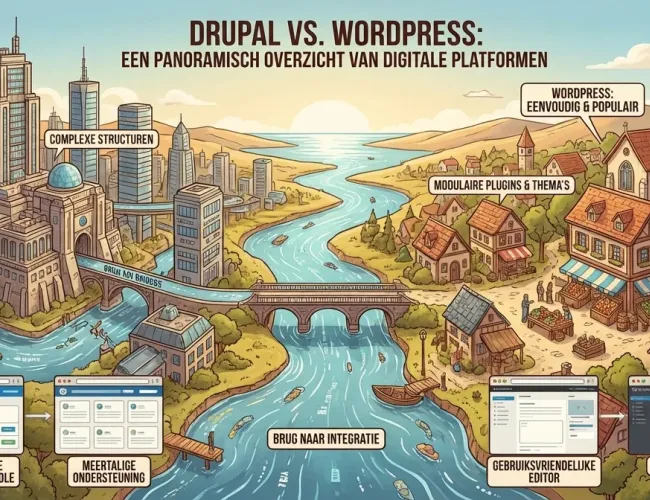
Although both systems run on open-source technology, the underlying philosophy is fundamentally different.
WordPress was traditionally designed as a user-friendly blogging platform that has evolved into a versatile system for almost any type of website.
Drupal, on the other hand, positions itself more as a powerful content management framework built specifically for complex data structures and heavy enterprise applications.
For Belgian businesses, this means the choice doesn't just depend on personal preference, but mainly on the technical requirements and the scalability you're aiming for in the long term.
The choice for drupal vs wordpress for large projects often comes down to the desired flexibility and the technical depth of the development team.
Ease of use and learning curve
For the average content editor, WordPress offers an intuitive interface that allows publishing articles and pages with little technical knowledge. The learning curve is relatively gentle, which explains why so many SMEs choose it.
Drupal, however, often requires a more technical background. Its admin interface is less “visual editor” focused and more geared toward managing complex relationships between content types. This makes Drupal more powerful but also more challenging for beginners who want quick results without help from a specialized web developer.
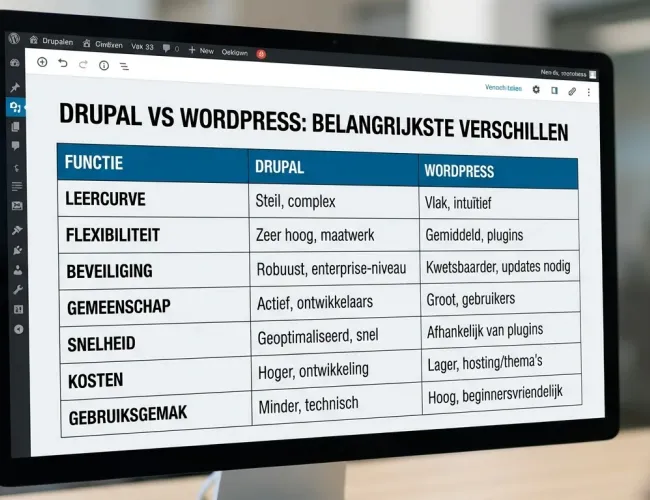
In practice, the Drupal vs WordPress comparison often comes down to a trade-off between immediate usability and structural robustness. WordPress is faster to set up; Drupal is better suited to highly specific custom requirements. It’s important to decide up front how much time you want to invest in learning the system. A wrong estimate can lead to frustration within your editorial team or unexpected costs for training and external support.
“The architectural foundation of a CMS determines not only what your site looks like today, but also how easily you can innovate tomorrow in a digital market.”
When evaluating Drupal vs WordPress for complex websites, Drupal clearly provides more advanced built-in features for permissions and taxonomies. Administrators can set highly granular access rights for different user groups essential for government institutions or large organizations with multiple departments.
WordPress can achieve similar results, but often relies on third-party plugins. Over time, that can impact stability and security if plugins are not properly maintained.
Speed and technical performance
In terms of performance, both systems can be excellent if they are configured properly by an expert.
Drupal includes an efficient built-in caching system and handles large volumes of data and many concurrent visitors very well. This is often a decisive factor for high-traffic environments.
WordPress more commonly depends on external caching solutions and server-level optimizations to reach comparable speeds. It’s important to understand that Drupal vs WordPress speed is influenced not only by the CMS itself, but also by hosting quality and the themes/plugins in use.
Daily usability and management for Belgian businesses
For day-to-day operations in an SME or a larger organization, the CMS interface plays a crucial role. The Drupal vs WordPress discussion is often about balancing immediate simplicity with structural depth.
For marketing teams who want to quickly publish a blog post or launch a campaign, WordPress feels familiar almost like working in a word processor.
Drupal has a steeper learning curve, but rewards you with exceptional control over complex data structures and multilingual setups which is especially valuable for organizations serving both Dutch-speaking and French-speaking audiences.
In practice, the choice often depends on who will maintain the website.
For freelancers and small businesses in regions such as Antwerp or Ghent, speed of updates is often a priority. When comparing Drupal vs WordPress for small businesses, WordPress enables building pages without technical knowledge through visual drag-and-drop editors, lowering the barrier for everyday management.
However, as a business grows and needs stricter roles and permissions, Drupal starts to show its strengths. Drupal allows highly specific permissions for different staff members, improving security and consistency in how content is managed.
Content flexibility and scalability
A key element in Drupal vs WordPress for complex business websites is how each system handles large amounts of information and multiple media types.
WordPress can become heavy if you stack too many plugins to add functionality. Drupal’s strength is that many capabilities are part of the core approach and architecture.
For Belgian businesses aiming for a seamless digital experience, managing product catalogs or extensive portfolios can often be structured more cleanly in Drupal. This creates a tidy back-end that remains clear over time, even as the website grows organically.
This kind of scalability is often the decisive factor for larger organizations.
Consider the needs of a growing company in the construction sector: a strong Drupal vs WordPress strategy takes the company’s future vision into account. In projects like the STG Group case, it becomes clear how a robust system supports professionals through a performant platform. Managing thousands of technical datasheets and images requires a structure that often feels more natural in Drupal for teams that prioritize stability.
“A CMS’s usability is not defined only by the first click, but by how efficiently you can still make complex changes after two years without breaking the structure.”
Ultimately, the Drupal vs WordPress comparison is about finding the right match for your team. If your staff wants fast, highly visual updates, WordPress often wins for immediate accessibility.
Security and scalability for your online platform
When you look at a website’s technical foundation, Drupal vs WordPress becomes critical for long-term stability.
Drupal is widely known in the industry as a robust platform and is often chosen by governments and large enterprises because of its advanced security architecture.
WordPress may appear simpler at first, but it requires a strict maintenance routine to avoid vulnerabilities in plugins. For Belgian SMEs dreaming of a platform that scales with their success, making the right architectural choices from the start is essential and in many cases, the Drupal vs WordPress decision around complex data structures becomes the key factor behind stability.
Security standards and updates
Your data security is closely tied to how the CMS handles third-party extensions and core updates.
In practice, Drupal uses a rigorous process for publishing modules, significantly reducing the risk of security issues. When choosing Drupal vs WordPress, you should consider how often updates happen and what impact they may have on your custom functionality.
WordPress has a huge community, but relying on third parties for critical functionality can become a risk if plugins are not updated on time.
The question “Which is safer for e-commerce: Drupal vs WordPress?” is one that often comes up among new webshop owners in Belgium.
Scalability for growing businesses
Scalability is not only about traffic volume — it’s also about how complex your content structure can become without sacrificing speed.
Drupal excels at managing thousands of concurrent users and complex taxonomies, which is why it’s often the ideal Drupal vs WordPress choice for enterprise solutions.
WordPress, however, can also deliver impressive performance for mid-sized projects when paired with the right caching and hosting setup.
If you want to learn more about the technical implementation: I want a new website that’s ready for the future.
- Drupal offers granular access controls for different user roles.
- WordPress stands out in usability for fast publishing workflows.
- Drupal vs WordPress performance depends heavily on server configuration.
“A secure platform is the invisible engine behind every successful digital growth story in the Belgian market.”
The final decision depends on your needs and technical ambitions in the long run.
Total cost and ongoing maintenance
When making the final call in Drupal vs WordPress, it’s important to look beyond initial setup costs.
Both platforms are open source, so there are no license fees — but the total investment can vary significantly depending on project complexity.
WordPress is known for getting you online quickly and relatively cheaply thanks to the abundance of ready-made themes.
Drupal often requires a larger budget for custom development and specialized developers, because the learning curve is steeper and the architecture needs to be set up more robustly for larger projects.
Maintenance and technical updates
Platform maintenance is a recurring cost that many Belgian SMEs and freelancers underestimate.
In practice, WordPress sites often require frequent plugin updates to close security gaps, while Drupal updates may be less frequent but can be more complex and require deeper technical expertise.
Comparing Drupal vs WordPress maintenance costs is therefore crucial for long-term planning.
“A website is never truly finished. It’s a living organism that needs constant care and security updates to keep performing well in search results.”
When we look specifically at Drupal vs WordPress security, Drupal is often less frequently targeted by automated attacks, but the cost per intervention can be higher. WordPress is easier for the average editor, which reduces internal training costs.
The final decision in Drupal vs WordPress for SEO therefore strongly depends on your available budget for technical management and the level of custom functionality you need.
- WordPress: lower entry costs, many inexpensive plugins, but more frequent updates.
- Drupal: higher initial investment, excellent for complex data structures, less frequent but heavier updates.
- Scalability: both can grow with your business, but Drupal often performs better at extremely high traffic levels.
Choose the Drupal vs WordPress option that best matches your growth strategy and technical capacity.
The Drupal vs WordPress debate is about your specific needs. If you choose WordPress, you get exceptional ease of use and a fast launch. Drupal offers the strength required for complex data structures and rock-solid security — crucial for larger organizations.
Ultimately, the winner in Drupal vs WordPress depends on your technical budget and the scalability you need. WordPress is ideal for content marketing and SME websites, while Drupal shines in custom builds and heavy integrations.
Need help choosing the right platform for your digital project? Our experts are ready to take your platform to the next level. Contact us today for a no-obligation consultation and discover which system best fits your business goals.
Frequently Asked Questions
What is the biggest difference between Drupal and WordPress for an SME?
WordPress is mainly known for its ease of use and quick setup, while Drupal is much more powerful for complex websites with lots of data. When weighing drupal vs wordpress, smaller businesses often choose the convenience of WordPress, while larger organisations prefer the scalability of Drupal.
What about security when choosing between drupal vs wordpress?
Drupal is generally considered the more secure of the two systems, partly due to the strict security protocols maintained by the community. WordPress is more often targeted by hackers because it's the most widely used platform worldwide, which requires extra vigilance and updates.
Why would a developer choose Drupal over WordPress?
A developer often chooses Drupal when there's a need for a flexible architecture for custom content types and complex access rights. It offers more technical freedom for custom solutions that go beyond the standard functionality of an average website.
When is WordPress the best option for my new project?
WordPress is the ideal choice when you want to get online quickly with a blog, a simple webshop or a business website you want to manage easily yourself. Thanks to the huge number of available themes and plugins, you can achieve a professional result without much technical knowledge.
A question about this topic?
Briefly describe your situation, and I'll let you know what's going on and what it would cost. No sales pitch.